Same task, same model. Two thirds fewer tokens.
A product API — pagination, per-IP rate limiting, request logging. Haiku, three runs per arm.
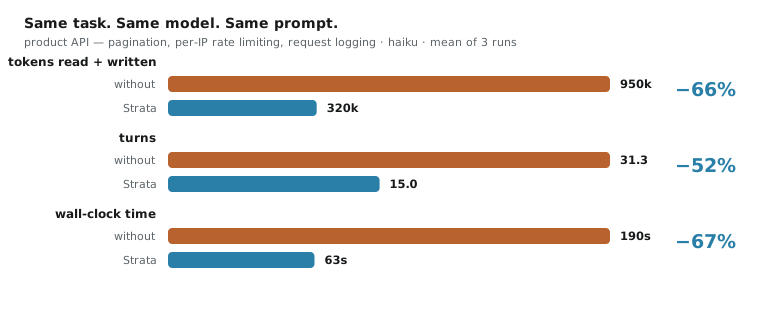
| Per run | Without Strata | With Strata | Change |
|---|---|---|---|
| tokens | 950,011 | 319,604 | −66% |
| turns | 31.3 | 15.0 | −52% |
| wall-clock | 190s | 63s | 3× faster |
| cost | $0.190 | $0.077 | −59% |
| checks passed | 70.8% | 100% | — |
The checks it failed are not cosmetic.
Real failures, from real runs. All of it code that runs, returns 200, and looks done.
HTTP/1.1 400 Bad Request
Content-Type: text/html; charset=utf-8

<!DOCTYPE html>
<html lang="en"><head><title>Error</title></head>
<body>
<pre>SyntaxError: Unexpected end of JSON input
    at JSON.parse (<anonymous>)
    at parse (C:\Users\...\node_modules\body-parser
              \lib\types\json.js:96:19)
    at C:\Users\...\body-parser\lib\read.js:128:18
    at AsyncResource.runInAsyncScope (node:async_h…
HTTP/1.1 400 Bad Request
Content-Type: application/json

{
  "error": "malformed JSON in request body",
  "details": [
    { "field": "body",
      "message": "could not be parsed as JSON" }
  ]
}
Both answered 400. Only one is safe. Failed 6 of 6 unaided runs, passed 6 of 6 with Strata — and no session ever mentioned it.
A retry with a different body was accepted
POST /orders Key: k-1 { "items": [ A ] } → 201 Created POST /orders Key: k-1 { "items": [ B ] } → 200 OK, order AThe client asked for a different order and was told it succeeded. Order B never exists. Should be 409.
Failed 3 of 3 unaided · passed 3 of 3 with Strata.The page size was ignored
GET /products?limit=5 → 200 OK, 10 itemsPagination that returns whatever it likes. Nothing errors. Nothing logs.
One unaided run in three.Your schema was edited, unasked
task: "a retried order request must not create two orders" modified: prisma/schema.prismaThe task never mentions the data model. No Strata run touched it.
Unaided: 6 files across 3 runs, only 3 every time. Strata: the same 10, every time.Run it three times. Get the same answer three times.
Not whether one run was good — whether the next one matches.
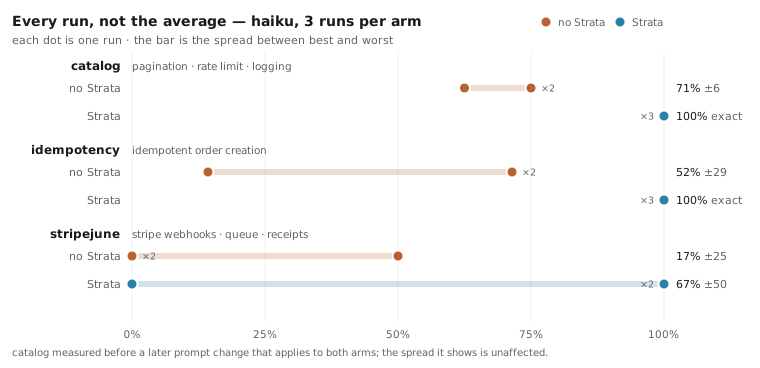
| Task | Without Strata | With Strata | Spread |
|---|---|---|---|
| product API | 63% · 75% · 75% | 100% · 100% · 100% | 0.0 pts |
| idempotent orders | 14% · 71% · 71% | 100% · 100% · 100% | 0.0 pts |
| payments + queue | 0% · 0% · 50% | 0% · 100% · 100% | 50 pts |
Spread with Strata, on the tasks its library covers. Without it, 26.9 points on the same prompt.
One unaided run of a prompt that scored 71% twice. Its create endpoint rejected every request shape, so five checks collapsed at once. A cliff, not a worse result.
Baseline runs that got a rate limiter’s refill right — at every tier. With Strata, 6/6.
Where it doesn’t hold
On payments, Strata covers the webhook and nothing else — 0.95×, a wash, and both arms shipped a build that does not run. The advantage tracks coverage. Strata also declines outright, about a third of the time.
Method
n=3, Claude Haiku 4.5. Checks frozen before the first run, each with a control proving it can fail. Graded by a separate suite — never Strata’s own verifier. Full method and per-run scores →